




Killing TPP, Bad News for Americans but Great for China

Rabu, 25 Januari 2017 - 06:06 WIB
Killing TPP, Bad News for Americans but Great for China
A
A
A
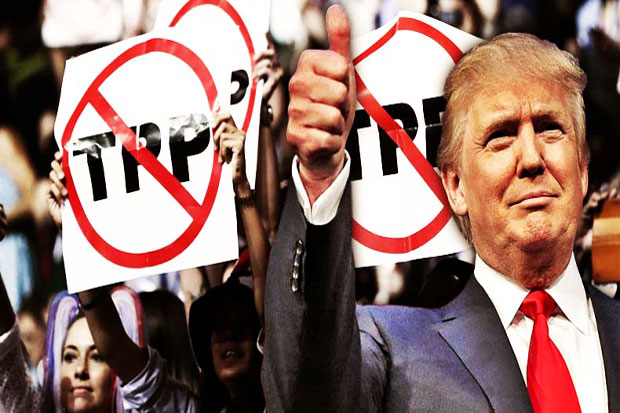
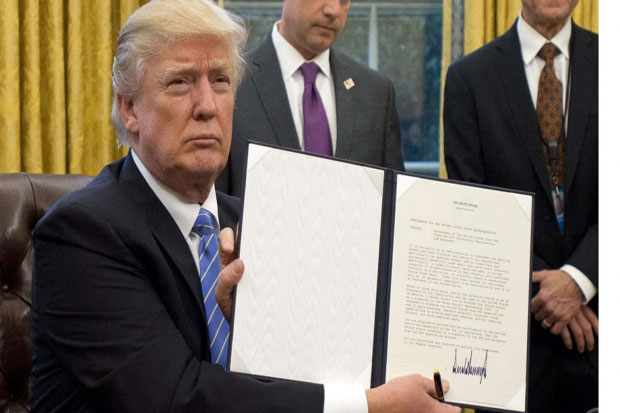
WASHINGTON DC - It's now clear that the election of Donald Trump will dramatically alter the shape of the world's economy for the foreseeable future. But based on his executive action to withdraw from the negotiating process of the Trans-Pacific Partnership (TPP), this reshaping will not be for the benefit of US workers and citizens.
Rather, the bulk of American workers, consumers and businesses likely will be hurt by the unfolding of US trade policies under President Trump. oday's action means that TPP is dead. Without ratification by the US Congress, it dies. Some workers' high-paying jobs in the US will be saved.
However, based upon sound estimates from the two most respected economic analyses of TPP -- the Petri-Plummer study from the Peterson Institute in Washington, DC, and the US International Trade Commission study -- the vast bulk of workers, businesses, and consumers in the US will lose out on this.
For instance, using the Petri-Plummer estimates, not only business owners would have gained (about 0.4 percent annually), but workers would have gained 0.5 percent more real income per year once fully implemented.
Moreover, less educated workers would have gained almost as much as more educated workers. We all lose the benefits of the greater productivity and lower prices that TPP would have provided.
Second, the vacuum will be filled. While not perfect, markets for good and services are basically efficient. In a global competition for economic growth by the 200 or so countries in the world, the evolution of trade policies by countries is also like a market.
Even as TPP (which excluded China) was being negotiated, another extensive trade agreement -- though lesser known -- has been under discussion. China and 15 other Asia-Pacific Rim countries have been negotiating the Regional Comprehensive Economic Partnership (RCEP) agreement since 2012.
The final RCEP agreement, which is a major trade policy undertaking of nearly the scope of the TPP, but including China, Japan, India, Australia, and South Korea to name a few countries, will provide, when ratified, a ready opportunity for 16 Asia-Pacific Rim governments to advance further the lowering of trade barriers and enhance their global interactions.
Last week, China's President Xi Jinping attended for the first time the World Economic Forum in Davos and spoke on the benefits that globalization and reduced trade barriers has provided for China. He made a clear statement that the Chinese government is happy to take the lead in fostering globalization, and earlier remarks have suggested that RCEP negotiations will move forward.
![Killing TPP, Bad News for Americans but Great for China]()
Unfortunately, this means the rules for global commerce will increasingly be set by other nations -- not by the United States. More importantly, with the United States absent from RCEP, considerable trade will be diverted away from the US.
Third, another likely trade policy move by the new administration will be the renegotiation of the North American Free Trade Agreement (NAFTA).
It has been the case that large economies wield large influence in trade negotiations, and NAFTA reflected the best interests of the United States 20 years ago, when the US economy was 10 times the size of Canada's and 25 times the size of Mexico's.
NAFTA took years to negotiate, and will likely take years to renegotiate. In the meantime, the uncertainty of the future of this trade relationship creates an immediate "tax" on businesses' profits and consequently workers' incomes.
There is now sound economic evidence of the cost of trade policy uncertainty. Moreover, the tax has already been implemented; the recent sharp depreciation of the Mexican peso relative to the US dollar implies that the dollar has appreciated relative to the peso, which hurts US competitiveness. We are already incurring costs of a future renegotiation.
The solution to increased globalization is not to attempt to halt it. We learned from the 1930s that spiraling protectionism tipped a severe recession over the edge to become the Great Depression.
Jeffrey H. Bergstrand,
Professor of Finance, Economics and Global Affairs
University of Notre Dame
Rather, the bulk of American workers, consumers and businesses likely will be hurt by the unfolding of US trade policies under President Trump. oday's action means that TPP is dead. Without ratification by the US Congress, it dies. Some workers' high-paying jobs in the US will be saved.
However, based upon sound estimates from the two most respected economic analyses of TPP -- the Petri-Plummer study from the Peterson Institute in Washington, DC, and the US International Trade Commission study -- the vast bulk of workers, businesses, and consumers in the US will lose out on this.
For instance, using the Petri-Plummer estimates, not only business owners would have gained (about 0.4 percent annually), but workers would have gained 0.5 percent more real income per year once fully implemented.
Moreover, less educated workers would have gained almost as much as more educated workers. We all lose the benefits of the greater productivity and lower prices that TPP would have provided.
Second, the vacuum will be filled. While not perfect, markets for good and services are basically efficient. In a global competition for economic growth by the 200 or so countries in the world, the evolution of trade policies by countries is also like a market.
Even as TPP (which excluded China) was being negotiated, another extensive trade agreement -- though lesser known -- has been under discussion. China and 15 other Asia-Pacific Rim countries have been negotiating the Regional Comprehensive Economic Partnership (RCEP) agreement since 2012.
The final RCEP agreement, which is a major trade policy undertaking of nearly the scope of the TPP, but including China, Japan, India, Australia, and South Korea to name a few countries, will provide, when ratified, a ready opportunity for 16 Asia-Pacific Rim governments to advance further the lowering of trade barriers and enhance their global interactions.
Last week, China's President Xi Jinping attended for the first time the World Economic Forum in Davos and spoke on the benefits that globalization and reduced trade barriers has provided for China. He made a clear statement that the Chinese government is happy to take the lead in fostering globalization, and earlier remarks have suggested that RCEP negotiations will move forward.
Unfortunately, this means the rules for global commerce will increasingly be set by other nations -- not by the United States. More importantly, with the United States absent from RCEP, considerable trade will be diverted away from the US.
Third, another likely trade policy move by the new administration will be the renegotiation of the North American Free Trade Agreement (NAFTA).
It has been the case that large economies wield large influence in trade negotiations, and NAFTA reflected the best interests of the United States 20 years ago, when the US economy was 10 times the size of Canada's and 25 times the size of Mexico's.
NAFTA took years to negotiate, and will likely take years to renegotiate. In the meantime, the uncertainty of the future of this trade relationship creates an immediate "tax" on businesses' profits and consequently workers' incomes.
There is now sound economic evidence of the cost of trade policy uncertainty. Moreover, the tax has already been implemented; the recent sharp depreciation of the Mexican peso relative to the US dollar implies that the dollar has appreciated relative to the peso, which hurts US competitiveness. We are already incurring costs of a future renegotiation.
The solution to increased globalization is not to attempt to halt it. We learned from the 1930s that spiraling protectionism tipped a severe recession over the edge to become the Great Depression.
Jeffrey H. Bergstrand,
Professor of Finance, Economics and Global Affairs
University of Notre Dame
(rnz)