




Amazing... Indonesia Homeless World Cup Team Includes Disabled Athlete

Kamis, 30 Juni 2016 - 12:38 WIB
Amazing... Indonesia Homeless World Cup Team Includes Disabled Athlete
A
A
A
BANDUNG - Indonesia’s team at the 2016 Homeless World Cup (HWC) will be completely different from its previous teams in the annually held international street soccer competition
After years of being the only national team to send members declared HIV positive to an international competition, this year the country’s HWC team will include a disabled person as a team member.
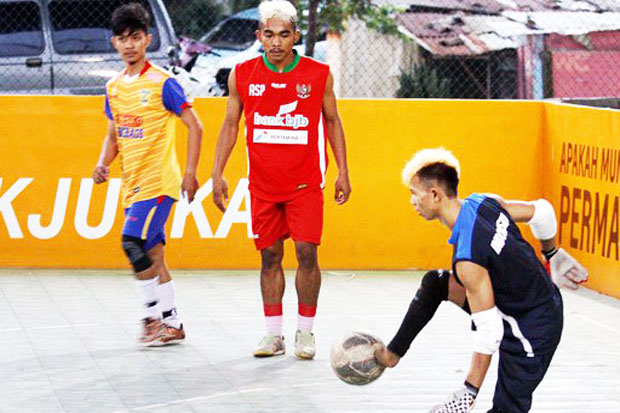
Ginan Koesmayadi of Cemara House, the national partner for HWC in Indonesia, said the participation of 27 year old Eman Sulaeman, who was born with severely disabled legs, would share his struggle in life with the world.
“We want to convey a message to the general public, who still think that sport should merely be focused on achievement. For us, sport is a strategic medium for social empowerment. Therefore, Eman’s presence in this year’s tournament will serve as a differentiator,” said Ginan, the first Indonesian who publicly declared himself HIV positive in the 2000s as reported The Jakarta Post, recently.
Eman said he dared to join the selection test for the 2016 HWC after he was encouraged by his friends in Majalengka, West Java. Eman, who works as a cellphone repairman, has been accustomed to playing soccer with his able-bodied friends. He has always been the goalkeeper.
Physically, Eman is different. He has no right foot and no left leg below the knee. If he stands up, he can only rely on the power of his right foot.
“I’ve got artificial legs but I seldom use them because they are heavy,” said the graduate of the State Maja I Vocational High School in Majalengka.
Eman looked very confident in the Bandung Wetan soccer field, where he used to train with the professional DKRC Fusion soccer club. He repeatedly flopped himself down to block the shots from the opposing team. To kick the ball, he uses his right leg.
On July 7, Eman and the other seven team members: Nandi Saiful Anam, Heru Muhamad Faisal, Wisnu Wantoro, Roni Syahroni Syamsudin and Angga Sidik Permadi from West Java; Wira Danu Hendro Prasetyoko from Bali, and Antonius Dhimas Anindhito from Yogyakarta, will fly to Scotland. They will participate in the 2016 HWC, which will be held at Glasgow’s George Square from July 10-16. Apart from Eman, two of the Indonesian players are HIV positive and another is a drug user.
The international competition, which provides an opportunity for people from socially marginalized groups to perform, will see 64 teams compete for the championship title. The annual competition began in Braz, Austria, in 2003.
Mel Young, the initiator and president of HWC, said the competition had touched lives and contributed to changes to at least 100,000 homeless people worldwide through soccer. “Together, we can change lives through football,” Young said in the official HWC Website.
He expressed the hope that HWC activities would receive widespread support from people worldwide.
“We need to galvanize our global fan base if we’re really going to make a difference. My message to people always is do small things. If we all do something small, we’ll change the world,” Young elaborated further on the website.
Ginan shared Young’s sentiment, saying that Indonesia’s participation in the annual HWC was not an easy job to fulfill as every year Cemara House has to seek financial support in order to be able to send the team to the competition.
“It is true that not all of them [team members] can automatically become professional athletes as our participation in the HWC is to help change people’s lives or change people’s perspectives of homeless people. There are two alumni of the Indonesian HWC who have died, one because he did not take the ARV medicine he was supposed to and another because of re-consuming drugs,” Ginan said.
He, however, also gave examples of success stories from the HWC alumni, such as Andri Kustiawan, who become a professional soccer player and has been in the last two years the top scorer in the National Futsal League. Another is Bonsu Hazibuan, who is now the coach of the professional team Vamos FC. Two other alumni have been recruited as civil servants upon serving rehabilitation programs at the National Narcotics Agency (BNN).
The team itself had previously met with the Minister of Youth and Sports (Affairs) Imam Nahrawi. Imam took off Indonesia's national team following the departure of championship Homeless World Cup (HWC) 2016, held in Glasgow, Scotland, July 10 to 16 next.
In addition to the HWC, Rumah Cemara also sent a team to follow the Street Football World Festival U-18 in Lyon, France on July 1 to 7, 2016. The Chairman of the Indonesian Community Sports Federation (FORMI), hayono isman and representatives of the Association of Street Soccer Indonesia, attended the release national team which took place in Kemenpora building, Friday (24/6).
After years of being the only national team to send members declared HIV positive to an international competition, this year the country’s HWC team will include a disabled person as a team member.
Ginan Koesmayadi of Cemara House, the national partner for HWC in Indonesia, said the participation of 27 year old Eman Sulaeman, who was born with severely disabled legs, would share his struggle in life with the world.
“We want to convey a message to the general public, who still think that sport should merely be focused on achievement. For us, sport is a strategic medium for social empowerment. Therefore, Eman’s presence in this year’s tournament will serve as a differentiator,” said Ginan, the first Indonesian who publicly declared himself HIV positive in the 2000s as reported The Jakarta Post, recently.
Eman said he dared to join the selection test for the 2016 HWC after he was encouraged by his friends in Majalengka, West Java. Eman, who works as a cellphone repairman, has been accustomed to playing soccer with his able-bodied friends. He has always been the goalkeeper.
Physically, Eman is different. He has no right foot and no left leg below the knee. If he stands up, he can only rely on the power of his right foot.
“I’ve got artificial legs but I seldom use them because they are heavy,” said the graduate of the State Maja I Vocational High School in Majalengka.
Eman looked very confident in the Bandung Wetan soccer field, where he used to train with the professional DKRC Fusion soccer club. He repeatedly flopped himself down to block the shots from the opposing team. To kick the ball, he uses his right leg.
On July 7, Eman and the other seven team members: Nandi Saiful Anam, Heru Muhamad Faisal, Wisnu Wantoro, Roni Syahroni Syamsudin and Angga Sidik Permadi from West Java; Wira Danu Hendro Prasetyoko from Bali, and Antonius Dhimas Anindhito from Yogyakarta, will fly to Scotland. They will participate in the 2016 HWC, which will be held at Glasgow’s George Square from July 10-16. Apart from Eman, two of the Indonesian players are HIV positive and another is a drug user.
The international competition, which provides an opportunity for people from socially marginalized groups to perform, will see 64 teams compete for the championship title. The annual competition began in Braz, Austria, in 2003.
Mel Young, the initiator and president of HWC, said the competition had touched lives and contributed to changes to at least 100,000 homeless people worldwide through soccer. “Together, we can change lives through football,” Young said in the official HWC Website.
He expressed the hope that HWC activities would receive widespread support from people worldwide.
“We need to galvanize our global fan base if we’re really going to make a difference. My message to people always is do small things. If we all do something small, we’ll change the world,” Young elaborated further on the website.
Ginan shared Young’s sentiment, saying that Indonesia’s participation in the annual HWC was not an easy job to fulfill as every year Cemara House has to seek financial support in order to be able to send the team to the competition.
“It is true that not all of them [team members] can automatically become professional athletes as our participation in the HWC is to help change people’s lives or change people’s perspectives of homeless people. There are two alumni of the Indonesian HWC who have died, one because he did not take the ARV medicine he was supposed to and another because of re-consuming drugs,” Ginan said.
He, however, also gave examples of success stories from the HWC alumni, such as Andri Kustiawan, who become a professional soccer player and has been in the last two years the top scorer in the National Futsal League. Another is Bonsu Hazibuan, who is now the coach of the professional team Vamos FC. Two other alumni have been recruited as civil servants upon serving rehabilitation programs at the National Narcotics Agency (BNN).
The team itself had previously met with the Minister of Youth and Sports (Affairs) Imam Nahrawi. Imam took off Indonesia's national team following the departure of championship Homeless World Cup (HWC) 2016, held in Glasgow, Scotland, July 10 to 16 next.
In addition to the HWC, Rumah Cemara also sent a team to follow the Street Football World Festival U-18 in Lyon, France on July 1 to 7, 2016. The Chairman of the Indonesian Community Sports Federation (FORMI), hayono isman and representatives of the Association of Street Soccer Indonesia, attended the release national team which took place in Kemenpora building, Friday (24/6).
(rnz)