




Obama's Do Over on His Message to Americans

Rabu, 09 Desember 2015 - 17:54 WIB
Obama's Do Over on His Message to Americans
A
A
A
WASHINGTON - The President took another crack at giving a pep talk to the American people over the cresting fear of terrorism and anti-refugee sentiment during a press conference Tuesday with French President Francois Hollande, told CNN, today.
The event was designed to display solidarity between the two countries following the recent terror attacks in Paris -- which both presidents made sure it did. But Obama also used it to salve his own political vulnerabilities, exacerbated by sparring matches with reporters during his trip abroad last week that were poorly received at home.
The President's comments were his most expansive yet on how Americans should view the aftermath of the ISIS-claimed killing spree. But while they might stabilize him politically, they also underscore his deeper struggle to produce a long-term strategy to eliminate the threat from ISIS, which now appears to be turning its sights to terror attacks outside of its self-declared caliphate in Syria and Iraq. And though Obama and Hollande both vowed to intensify air strikes on the extremist group, he offered little new in the way of strategic thinking.
The President began by delivering a moving tribute to the "joie de vivre" and cultural and historical greatness of France and later warned Russia to stop targeting moderate Syrian rebels in some of his more pointed comments of the event.
But he also delivered a personal, distinctly political -- if still unifying -- message to Americans, providing the kind of reassurance, national rallying call and quiet resolution critics deemed missing from his appearances while he was in Turkey and Asia last week.
A direct appeal to Americans
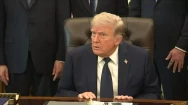
Indeed, Obama seized the podium at the White House Tuesday and spoke directly to the American as well as French people.
"Francois, with your understanding, my statement today will be a little longer than usual. I have been traveling and this is an important moment for our nations and for the world," Obama said, in an apparent admission his earlier remarks following the Paris terror attacks 10 days ago had been lacking.
"What happened in Paris is truly horrific. I understand that people worry that something similar could happen here. I want you to know that we will continue to do everything in our power to defend our nation," Obama said.
For all his speech-making skills, Obama has admitted several times publicly that his communication strategy as president has sometimes been lacking. On occasion, he has either seemed to underestimate the political impact of an event or required several attempts to craft an appropriate message.
For example, over Christmas 2009, he struggled to keep up with rapidly evolving news coverage after an al Qaeda operative attempted to bring down a U.S. airliner over Detroit, possibly because he was thousands of miles away from the political tumult enjoying his annual vacation in his native Hawaii.
Nearly six years on, Obama, who often seems to disdain the more theatrical tasks of the presidency, appears to still have some work to do on presentation. A CBS News poll published on Monday found that 66% of Americans believe that he does not yet have a clear plan for defeating ISIS. And a new Washington Post poll on Tuesday found that the President's approval rating on handling terrorism had toppled to a new low of 40%, down seven points from January. And his overall approval rating has dipped back to 45%, down from 51% in October.
Obama might have been criticized back home for his initial response to the Paris attacks, but there was no complaint from Hollande, who warmly praised the President's swift vows of support for France in the immediate hours after the assaults.
"He was the first one to call me," Hollande noted. "It was very late in France, 2.00 a.m. when Barack called -- the President of the United States," Hollande went on, praising Obama for his "emotion, his compassion against the horror."
The event was designed to display solidarity between the two countries following the recent terror attacks in Paris -- which both presidents made sure it did. But Obama also used it to salve his own political vulnerabilities, exacerbated by sparring matches with reporters during his trip abroad last week that were poorly received at home.
The President's comments were his most expansive yet on how Americans should view the aftermath of the ISIS-claimed killing spree. But while they might stabilize him politically, they also underscore his deeper struggle to produce a long-term strategy to eliminate the threat from ISIS, which now appears to be turning its sights to terror attacks outside of its self-declared caliphate in Syria and Iraq. And though Obama and Hollande both vowed to intensify air strikes on the extremist group, he offered little new in the way of strategic thinking.
The President began by delivering a moving tribute to the "joie de vivre" and cultural and historical greatness of France and later warned Russia to stop targeting moderate Syrian rebels in some of his more pointed comments of the event.
But he also delivered a personal, distinctly political -- if still unifying -- message to Americans, providing the kind of reassurance, national rallying call and quiet resolution critics deemed missing from his appearances while he was in Turkey and Asia last week.
A direct appeal to Americans
Indeed, Obama seized the podium at the White House Tuesday and spoke directly to the American as well as French people.
"Francois, with your understanding, my statement today will be a little longer than usual. I have been traveling and this is an important moment for our nations and for the world," Obama said, in an apparent admission his earlier remarks following the Paris terror attacks 10 days ago had been lacking.
"What happened in Paris is truly horrific. I understand that people worry that something similar could happen here. I want you to know that we will continue to do everything in our power to defend our nation," Obama said.
For all his speech-making skills, Obama has admitted several times publicly that his communication strategy as president has sometimes been lacking. On occasion, he has either seemed to underestimate the political impact of an event or required several attempts to craft an appropriate message.
For example, over Christmas 2009, he struggled to keep up with rapidly evolving news coverage after an al Qaeda operative attempted to bring down a U.S. airliner over Detroit, possibly because he was thousands of miles away from the political tumult enjoying his annual vacation in his native Hawaii.
Nearly six years on, Obama, who often seems to disdain the more theatrical tasks of the presidency, appears to still have some work to do on presentation. A CBS News poll published on Monday found that 66% of Americans believe that he does not yet have a clear plan for defeating ISIS. And a new Washington Post poll on Tuesday found that the President's approval rating on handling terrorism had toppled to a new low of 40%, down seven points from January. And his overall approval rating has dipped back to 45%, down from 51% in October.
Obama might have been criticized back home for his initial response to the Paris attacks, but there was no complaint from Hollande, who warmly praised the President's swift vows of support for France in the immediate hours after the assaults.
"He was the first one to call me," Hollande noted. "It was very late in France, 2.00 a.m. when Barack called -- the President of the United States," Hollande went on, praising Obama for his "emotion, his compassion against the horror."
(rnz)