




US Navy Strike Group Move Toward to Korean Peninsula

Minggu, 09 April 2017 - 21:37 WIB
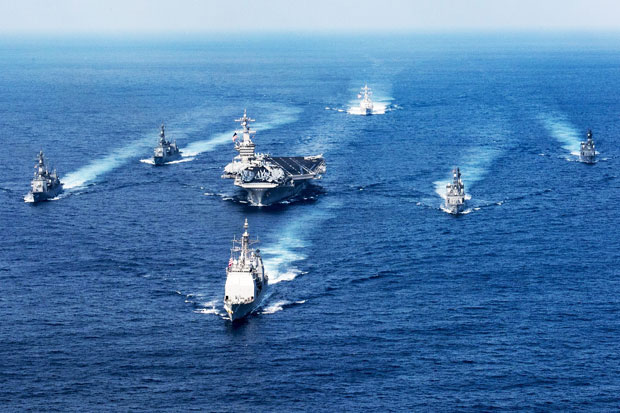
US Navy Strike Group Move Toward to Korean Peninsula
A
A
A
WASHINGTON DC - A United States (US) Navy strike group will be moving toward the western Pacific Ocean near the Korean peninsula as a show of force. A US official told on Saturday, as concerns grow about North Korea's advancing weapons program.
Secretary of State, Rex Tillerson also said China agrees with the Trump administration that “action has to be taken” regarding North Korea.
Tillerson told in an interview broadcast on Sunday, that when Donald Trump and Chinese president Xi Jinping met at Mar-a-Lago this week, they “had extensive discussions around the dangerous situation in North Korea”.
“President Xi clearly understands, and I think agrees, that the situation has intensified and has reached a certain level of threat that action has to be taken,” Tillerson said.
He described a “shared view and no disagreement as to how dangerous the situation has become”.
In view of the regional threat now posed by North Korean missile tests and nuclear ambitions, he said, the Chinese “do not believe the conditions are right today to engage in discussions with the government in Pyongyang”.
“We’re hopeful that we can work together with the Chinese to change the conditions in the minds of the DPRK leadership. And then, at that point, perhaps discussions may be useful. But I think there’s a shared view and no disagreement as to how dangerous the situation has become. And I think even China is beginning to recognize that this presents a threat to even to China’s interests as well,” he added,
The Carl Vinson strike group, which includes an aircraft carrier, was first scheduled to make port calls in Australia but is now on its way from Singapore to the western Pacific Ocean.
“US Pacific Command ordered the Carl Vinson strike group north as a prudent measure to maintain readiness and presence in the western Pacific,” said Commander Dave Benham, spokesman at US Pacific Command.
“The No1 threat in the region continues to be North Korea, due to its reckless, irresponsible and destabilising program of missile tests and pursuit of a nuclear weapons capability,” he said, in an unusually forceful statement.
On Sunday, Trump national security adviser HR McMaster told Fox News Sunday the strike group had been moved because “it is prudent to do it”.
The news followed a Friday report by NBC that the National Security Council had included the return of nuclear weapons to South Korea in options presented to Trump for dealing with North Korea. Killing North Korea’s leader, Kim Jong-un, was also presented as an option.
On Saturday, White House said Trump had spoken to the acting president of South Korea, Hwang Kyo-Ahn. North Korea, meanwhile called the US missile strike on Syria on Thursday night “an intolerable act of aggression”.
The White House said Trump spoke with Hwang about the strike in Syria, launched in retaliation for a suspected chemical attack on civilians by Bashar al-Assad’s government. The two leaders agreed to stay in close contact, the White House said, regarding North Korea and other issues of mutual concern.
Analysts have said the Syria strike contained a clear message for Pyongyang that the US is not afraid to exercise the military option. Appearing on ABC’s This Week on Sunday, Tillerson strongly suggested as much, saying of Syria: “If you violate international agreements, if you fail to live up to commitments, if you become a threat to others, at some point a response is likely to be undertaken.”
Secretary of State, Rex Tillerson also said China agrees with the Trump administration that “action has to be taken” regarding North Korea.
Tillerson told in an interview broadcast on Sunday, that when Donald Trump and Chinese president Xi Jinping met at Mar-a-Lago this week, they “had extensive discussions around the dangerous situation in North Korea”.
“President Xi clearly understands, and I think agrees, that the situation has intensified and has reached a certain level of threat that action has to be taken,” Tillerson said.
He described a “shared view and no disagreement as to how dangerous the situation has become”.
In view of the regional threat now posed by North Korean missile tests and nuclear ambitions, he said, the Chinese “do not believe the conditions are right today to engage in discussions with the government in Pyongyang”.
“We’re hopeful that we can work together with the Chinese to change the conditions in the minds of the DPRK leadership. And then, at that point, perhaps discussions may be useful. But I think there’s a shared view and no disagreement as to how dangerous the situation has become. And I think even China is beginning to recognize that this presents a threat to even to China’s interests as well,” he added,
The Carl Vinson strike group, which includes an aircraft carrier, was first scheduled to make port calls in Australia but is now on its way from Singapore to the western Pacific Ocean.
“US Pacific Command ordered the Carl Vinson strike group north as a prudent measure to maintain readiness and presence in the western Pacific,” said Commander Dave Benham, spokesman at US Pacific Command.
“The No1 threat in the region continues to be North Korea, due to its reckless, irresponsible and destabilising program of missile tests and pursuit of a nuclear weapons capability,” he said, in an unusually forceful statement.
On Sunday, Trump national security adviser HR McMaster told Fox News Sunday the strike group had been moved because “it is prudent to do it”.
The news followed a Friday report by NBC that the National Security Council had included the return of nuclear weapons to South Korea in options presented to Trump for dealing with North Korea. Killing North Korea’s leader, Kim Jong-un, was also presented as an option.
On Saturday, White House said Trump had spoken to the acting president of South Korea, Hwang Kyo-Ahn. North Korea, meanwhile called the US missile strike on Syria on Thursday night “an intolerable act of aggression”.
The White House said Trump spoke with Hwang about the strike in Syria, launched in retaliation for a suspected chemical attack on civilians by Bashar al-Assad’s government. The two leaders agreed to stay in close contact, the White House said, regarding North Korea and other issues of mutual concern.
Analysts have said the Syria strike contained a clear message for Pyongyang that the US is not afraid to exercise the military option. Appearing on ABC’s This Week on Sunday, Tillerson strongly suggested as much, saying of Syria: “If you violate international agreements, if you fail to live up to commitments, if you become a threat to others, at some point a response is likely to be undertaken.”
(rnz)