





Old Crocodile Almost The Bus Size

Rabu, 13 Januari 2016 - 15:35 WIB
Old Crocodile Almost The Bus Size
A
A
A
TUNIS - Paleontologists searching far and wide in Tunisia made a discovery of massive proportions. The world's largest sea dwelling crocodile, previously unknown to science. This prehistoric crocodile is believed to have measured more than 30 feet long and weighed three tons. The skull alone is more than five feet long.
Researchers named the new species the Machimosaurus rex and described their findings this week in the journal Cretaceous Research.
"Massive" is how lead author Federico Fanti of the University of Bologna described the crocodile as told to Washington Post.
"It's just big. It's almost the size of a bus. It definitely was at the top of the food chain at the time, at least in this particular locality," he added.
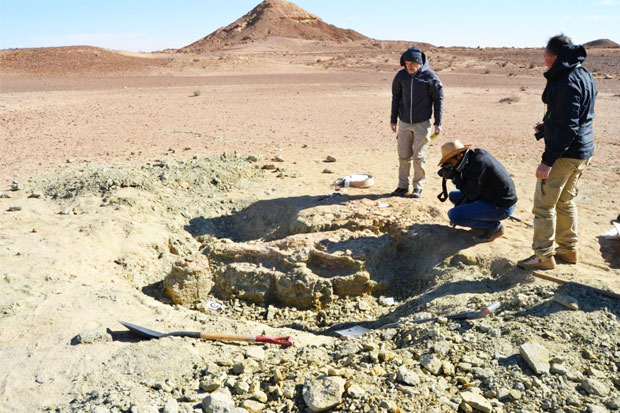
Committee for Research and Exploration, found the fossils buried below just a few inches of sediment on the edge of the Sahara Desert in Tunisia, a country rich with fossils.
"This one was a big surprise, not because we found fossils, but we found beautiful ones," Fanti said. The skull took two days to uncover, and the "rest of the body was just lying there."
This particular site was likely home to a lagoon that faced the ocean. Researchers also found the remains of fish and turtles that they still need to identify.
The M rex was "absolutely capable" of hunting in the water and could have been an ambush predator or a scavenger, Fanti said. Comparing M. rex to other crocodiles that also have big heads and short teeth suggests the M. rex had "a very incredibly powerful bite force" that would let it crush its food, Fanti said. Turtles, for instance, would have been an ideal meal.
This discovery is groundbreaking for reasons other than girth; Fanti said this finding undermines previous theories about prehistoric life. The group of crocodiles that M. rex belongs to was considered to have gone extinct about 150 million years ago at the end of the Jurassic Period, but this particular M. rex lived about 130 million years ago.
Previous studies pointed to "a big global extinction between the Jurassic and Cretaceous periods that wiped out a number of marine reptiles, including this group of reptiles," Fanti said. M. rex lived way after this "hypothesized mass extinction."
"That's leading us to consider the mass extinction theory is wrong and that we should better understand what's going on at the end of the Jurassic period," Fanti said.
Researchers named the new species the Machimosaurus rex and described their findings this week in the journal Cretaceous Research.
"Massive" is how lead author Federico Fanti of the University of Bologna described the crocodile as told to Washington Post.
"It's just big. It's almost the size of a bus. It definitely was at the top of the food chain at the time, at least in this particular locality," he added.
Committee for Research and Exploration, found the fossils buried below just a few inches of sediment on the edge of the Sahara Desert in Tunisia, a country rich with fossils.
"This one was a big surprise, not because we found fossils, but we found beautiful ones," Fanti said. The skull took two days to uncover, and the "rest of the body was just lying there."
This particular site was likely home to a lagoon that faced the ocean. Researchers also found the remains of fish and turtles that they still need to identify.
The M rex was "absolutely capable" of hunting in the water and could have been an ambush predator or a scavenger, Fanti said. Comparing M. rex to other crocodiles that also have big heads and short teeth suggests the M. rex had "a very incredibly powerful bite force" that would let it crush its food, Fanti said. Turtles, for instance, would have been an ideal meal.
This discovery is groundbreaking for reasons other than girth; Fanti said this finding undermines previous theories about prehistoric life. The group of crocodiles that M. rex belongs to was considered to have gone extinct about 150 million years ago at the end of the Jurassic Period, but this particular M. rex lived about 130 million years ago.
Previous studies pointed to "a big global extinction between the Jurassic and Cretaceous periods that wiped out a number of marine reptiles, including this group of reptiles," Fanti said. M. rex lived way after this "hypothesized mass extinction."
"That's leading us to consider the mass extinction theory is wrong and that we should better understand what's going on at the end of the Jurassic period," Fanti said.
(rnz)